
Broadleaf Weeds
As you might remember in the Types of Turfgrass Weeds blog, we told you that broadleaf weeds have leaves with a network of veins which are divided, and generally have a solid stem and main root system. Flowers are usually conspicuous. Here is a little information on various broadleaf weeds you may find in your yard.
Warm Season Broadleaf Weeds
Black Medic (Medicago lupulina)
Other Names: Yellow Trefoil
Life Span: Warm season annual
 Description: Black medic is a member of the legume family and can be confused with clovers. The dark green leaves alternate on the stem and each leaf consists of three leaflets. The leaflets are wedge-shaped with a small spur at the tip and prominent, parallel veins. The stems are prostrate, hairy, and rise from a crown area. The root consists of a strong taproot. Flowers are small, bright yellow compact clusters.
Yellow Woodsorrel (Oxalis)
Other Names: Oxalis
Life Span: Perennial/warm season annual
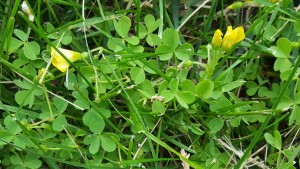 Description: Yellow woodsorrel can be confused with clover. The pale green leaves consist of three leaflets which are distinctly heart-shapes, and appear folded along the midrib. The branching stems are thin, sparsly hairy, and able to root at the nodes. The funnel-shaped flowers are small and yellow with five petals. As the flowers mature, a cylindrical seedpod is formed, which is five-sided and tapers to a point. Yellow woodsorrel is often found where the turf is thin or absent and grows from mid-spring to mid-fall.
Purslane (Portulaca oleracea)
Other Names: None
Life Span: Summer annual
D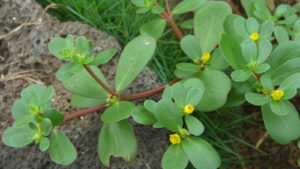 escription: In new seedling or thin, turf, purslane can become a very troublesome annual. Like many desert plants, it has the ability to store moisture for great lengths of time. It thrives in extremely hot, dry weather. The sprawling stems of purslane are thick, round, fleshy, and reddish-brown in color. Leaves are bright, shiny-green, wedge-shaped, rubbery, and thick. Purslane has tiny yellow flowers with five petals. These flowers seldom open unless the sun is shining brightly. The cup-shaped seedpods produce an abundance of small, black seeds. These seeds may lie dormant in the soil for many years.
Prostrate Spurge (Euphorbia supina) Spotted Spurge (Euphorbia maculate)
Other Names: None
Life Span: Warm season annual
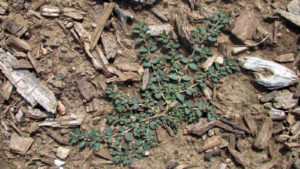 Description: Prostrate spurge and spotted spurge are similar in appearance. All plant parts contain a white, milky sap. The stems radiate from a taproot, forming a dense mat, especially in the case of prostrate spurge. Spotted spurge has smooth stems, while prostrate spurge has hairy stems. Leaves are opposite, oblong, and may have a reddish splotch in the center. The leaves of spotted spurge are somewhat toothed, while prostrate spurge has smooth leaves with some hairs on the underside. Small, inconspicuous flowers are produced in the upper leaf axils. Porstrate and spotted spurge germinate in late spring and bloom into September. They are usually a problem in thin, stressed turfs.
Field Bindweed (Convolvulus arvensis)
Other Names: Creeping Jenny
Life Span: Warm season perennial
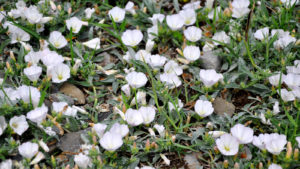 Description: Field bindweed usually invades thin, drought-stressed turf. The plant grows prostrate, close to the soil surface and is able to tolerate close mowing. The slender stems can grow several feet long and can climb short distances. The leaves are alternate, petioled, and are generally spade-shaped with pointed, basal lobes. The size and shape of the leaves vary depending on environmental conditions. Field bindweed reproduces from seed and extensive root system. The flowers are conspicuous, trumpet-shaped, and white or pink. Roots may extend 20 feet into the soil.
Cool Season Broadleaf Weeds
White Clover (Trifolium repens)
Other Names: White Dutch Clover
Life Span: Cool season perennial
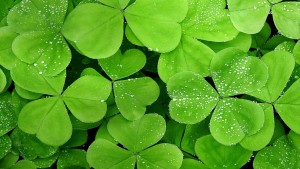 Description: White clover is a member of the legume family and can be confused with black medic. The dark green leaves alternate on the stem and each leaf consists of three leaflets. The leaflets have a white crescent-shaped mark and prominent parallel veins. The stems are prostrate, hairy, and able to root at the nodes. This enables the plant to withstand close mowing. Flowers are white, sometimes with a tint of pink. White clover resumes growth early in the spring and goes dormant during hot weather, leaving objectional brown areas in the turf.
Henbit (Lamium amplexicaule)
Other Names: None
Life Span: Winter annual/ cool season annual
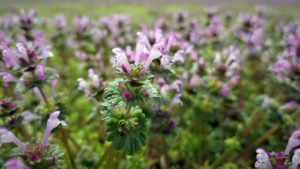 Description: Henbit is a member of the mint family and is often confused with ground ivy. It is generally a problem in newly seeded turfs established in the fall. Henbit has a four-sided, square stem. The leaves are hariy, rounded, coarsely lobed, deeply veined, and are opposite. Toward the base of the stem, the leaves are long, petioled, and toward the top the leaves clasp the stem. The flowers are tubular or trumpet-shaped, pink or purple in color, and rise from the leaf axils. Henbit flowers in early spring.
Ground Ivy (Glechoma microcarpa)
Other Names: Creeping Charlie
Life Span: Cool season perennial
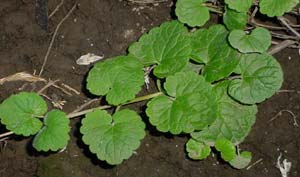 Description: Ground ivy is a member of the mint family which was originally introduced as a ground clover. Ground ivy thrives under shaded conditions but can be found in direct sun as well. Ground ivy spreads rapidly by creeping stems which are four-sided, square, and capable of rooting at the nodes. The leaves which rise on petioles from the stems are rounded, toothed, deeply veined, and are opposite. The flowers are tubular or trumpet-shaped, lavender in color, and arise from the leaf axils. Ground ivy flowers in the early spring.
Prostrate Knotweed (Polygonum aviculare)
Other names: Knotweed
Life Span: Cool season annual
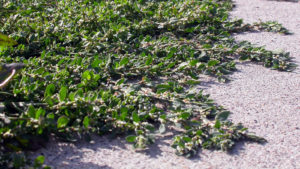 Description: Prostrate knotweed is a low growing annual which is typically found in compacted soil. It is one of the first plants to emerge each spring, with germination occurring in March. The stems, which radiate from a central taproot, are tough, slender, wiry, and produce mat-like growth. Leaves rise from the nodes which are surrounded by a thin, papery sheath. The leaves are dull green, alternate, oblong, and pointed at the tip. Flowers are small, inconspicuous, and in clusters in the leaf axils.
Dandelion (Taraxacum officinale)
Other Names: None
Life Span: Cool season perennial
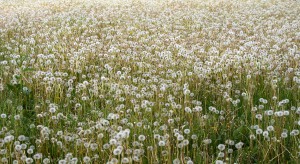 Description: Dandelion is probably the most widely recognized turfgrass weed. Dandelion is a simple perennial, having a thick, fleshy taproot which can penetrate into the soil 2 feet or more. The above ground portion consists of a rosette of basal leaves. The leaves are long, deeply notched, with the lobes pointing back toward the crown. Flower stalks rise from the crown area and are long, hollow, and hairy. Both the leaves and the flower stalk contain a white milky sap. The flowers produced on the stalks are bright yellow round clusters but turn into a white puff-ball full of seeds upon maturing. The seeds are attached to a long, parachute-like pappus, capable of carrying the seed great distances. It is one of the first plants to emerge each spring, but seedlings can occur throughout the growing season.
Blackseed Pantain (Plantago rugelii) Broadleaf Pantain (Plantago major)
Other Names: None
Life Span: Cool season perennial
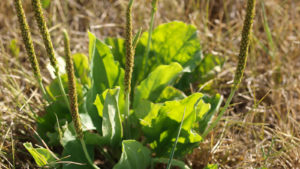 Description: Blackseed and broadleaf plantain are similar in appearance. The plantains are simple perennials, having a mostly shallow, fibrous root system. The above ground portion consists of a rosette of basal leaves. The leaves are large, oval to elliptic, with conspicuous veins, and have a long petiole attached to the crown. Blackseed plantain has purple coloration at the petiole base, while the petiole of broadleaf plantain is green and somewhat shorts. Long rat-tail like flower stalk extend up to 12 inches and produce numerous, inconspicuous flowers.
Violets (Viola spp.)
Other Names: None
Life Span: Cool season perennial
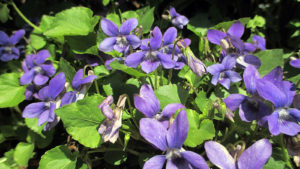 Description: Violets are one of the first plants to flower in the spring and are usually found in shaded, moist areas. The violets have a dense fibrous root system. The above ground portion is stemless, with heart-shaped basal leaves. The leaves are scalloped on the edge and attached to the crown by long petioles with prominent stipules. The flowers are borne on long stalks and are light blue to deep purple in color.
A select few Broadleaf weeds can be controlled with Natria Lawn Weed Control. To see which broadleaf weeds are controlled please visit the Natria blog.
Reference
R.E. Gaussoin and A. R. Martin. (1997). Turfgrass Weed Identification and Prevention. In F. Baxendale, Ph.D., & R. Gaussoin, Ph.D., Integrated Turfgrass Management for the Northern Great Plains (pp. 98-116). Location: Nebraska